quarkus-panache-swagger-blueprint
🔍 The N+1 Problem, Demonstrated
This page is a companion to the main README specifically the section on lazy loading silently breaking
through auto-generated endpoints. Rather than just describing the problem, this repo ships two real endpoints on the
Profile entity that do the exact same thing from the outside, but behave very differently underneath.
If you only read one part of this repo to understand why relation mapping matters before you copy an entity, make it this one.
The Two Endpoints
Both endpoints return the same ProfileStudentDto, for the same Profile. The only difference is how the student
relation is fetched.
❌ Unoptimized: N+1
This happens when findById invoked on an entity that have FK and need to access the fk’s fields triggers N+1
@GET
@Path("/full/{id : \\d+}/demo/n+1problem")
@Produces("application/json")
default ProfileStudentDto getAggregateDemoN1Problem(@PathParam("id") long id) {
    Profile p = Profile.findById(id);
    return new ProfileStudentDto(p, p.student);
}
✅ Optimized: single query via JOIN FETCH
@GET
@Path("/full/{id : \\d+}")
@Produces(MediaType.APPLICATION_JSON)
default ProfileStudentDto getAggregate(@PathParam("id") long id) {
    Profile p = Profile.findByIdWithStudent(id);
    return new ProfileStudentDto(p, p.student);
}
    public static Profile findByIdWithStudent(Long id) {
    return find("FROM Profile p LEFT JOIN FETCH p.student WHERE p.id = ?1", id)
            .firstResult();
}
From a Swagger / API-consumer point of view, these two endpoints are indistinguishable. Same response shape, same
status codes, same ProfileStudentDto. That’s exactly what makes this class a bit tricky, nothing about the contract
tells
you one of them is doing extra work behind the scenes.
What’s Actually Happening Underneath
Unoptimized (GET /profile/full/{id}/demo/n+1problem) |
Optimized (GET /profile/full/{id}) |
|
|---|---|---|
How student is fetched |
Profile.findById(id) loads Profile only. student stays an uninitialized lazy proxy. |
findByIdWithStudent(id) uses LEFT JOIN FETCH Profile and Student are loaded together in one round trip. |
| What triggers the extra query | The ProfileDto constructor reads dao.student, which forces Hibernate to initialize the proxy right there while the Hibernate session is still open (request-scoped), so it succeeds silently instead of throwing LazyInitializationException. |
Nothing to trigger because student is already a fully initialized object by the time the DTO is built. |
| Query count for 1 profile | 2 (1 for Profile, 1 for Student) |
1 |
| Query count for N profiles in a loop/list context | 1 + N | 1 (or 1 per page, if paginated) |
The unoptimized version doesn’t fail and that’s the trap. It returns the correct data, every time, in dev with a handful of rows. The cost only shows up as query count grows linearly with result size, which is usually invisible until either the database starts throttling under load or someone’s actually watching the SQL log.
The Evidence (Query Log)
[!NOTE] Reproduce this yourself, see steps below and fill in the actual numbers here. Placeholder values shown for format reference only.
Setup:
- add
quarkus.hibernate-orm.log.sql=trueto application.properties if the property not exists - single
Profilerow with itsStudentrelation populated.
| Endpoint | Queries executed |
|---|---|
GET /profile/full/1/demo/n+1problem |
2 queries |
GET /profile/full/1 |
1 query |
The Unoptimized API test result
Call the API using swagger
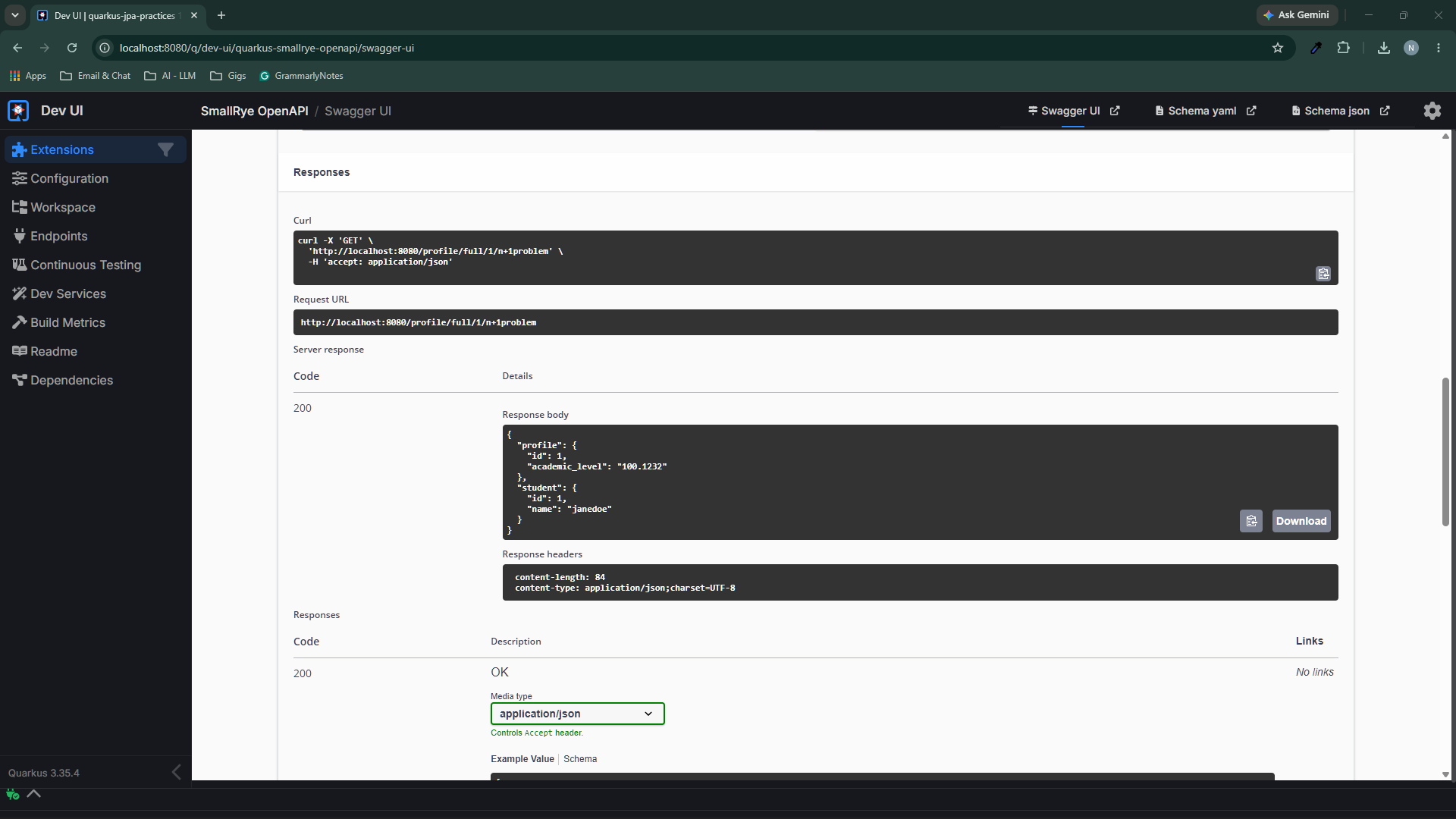
The log shown two SQL query from hibernate to database, 2 query call
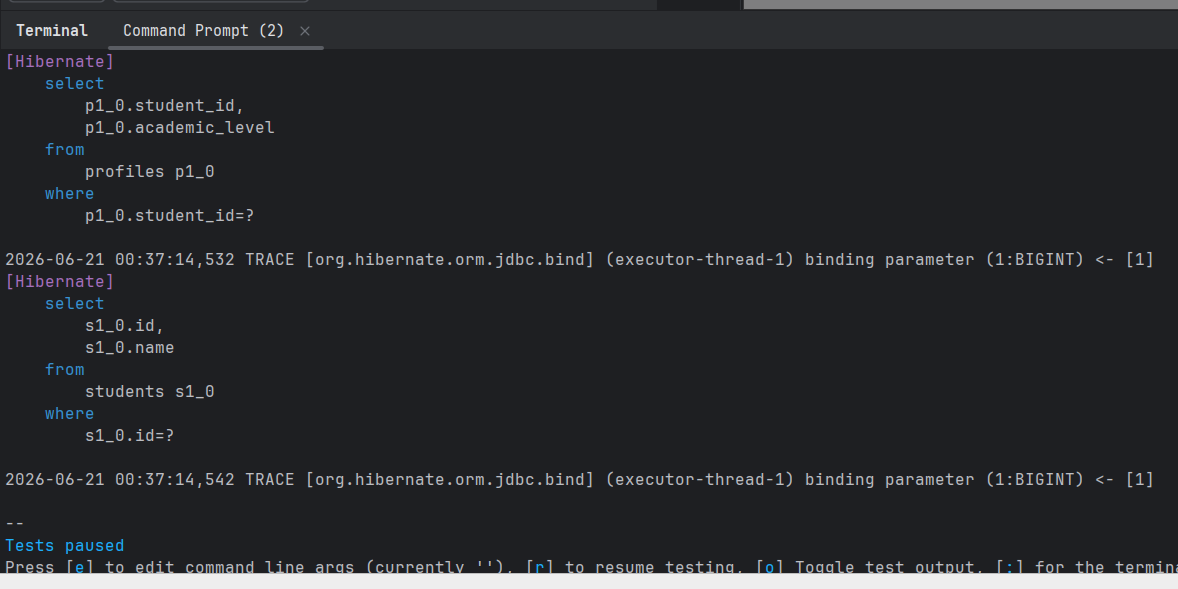
[Hibernate]
    select
        p1_0.student_id,
        p1_0.academic_level
    from
        profiles p1_0
    where
        p1_0.student_id=?

${timestamp} TRACE [org.hibernate.orm.jdbc.bind] (executor-thread-1) binding parameter (1:BIGINT) <- [1]
[Hibernate]
    select
        s1_0.id,
        s1_0.name
    from
        students s1_0
    where
        s1_0.id=?

${timestamp} TRACE [org.hibernate.orm.jdbc.bind] (executor-thread-1) binding parameter (1:BIGINT) <- [1]
The Optimized API test result
Call the API using swagger
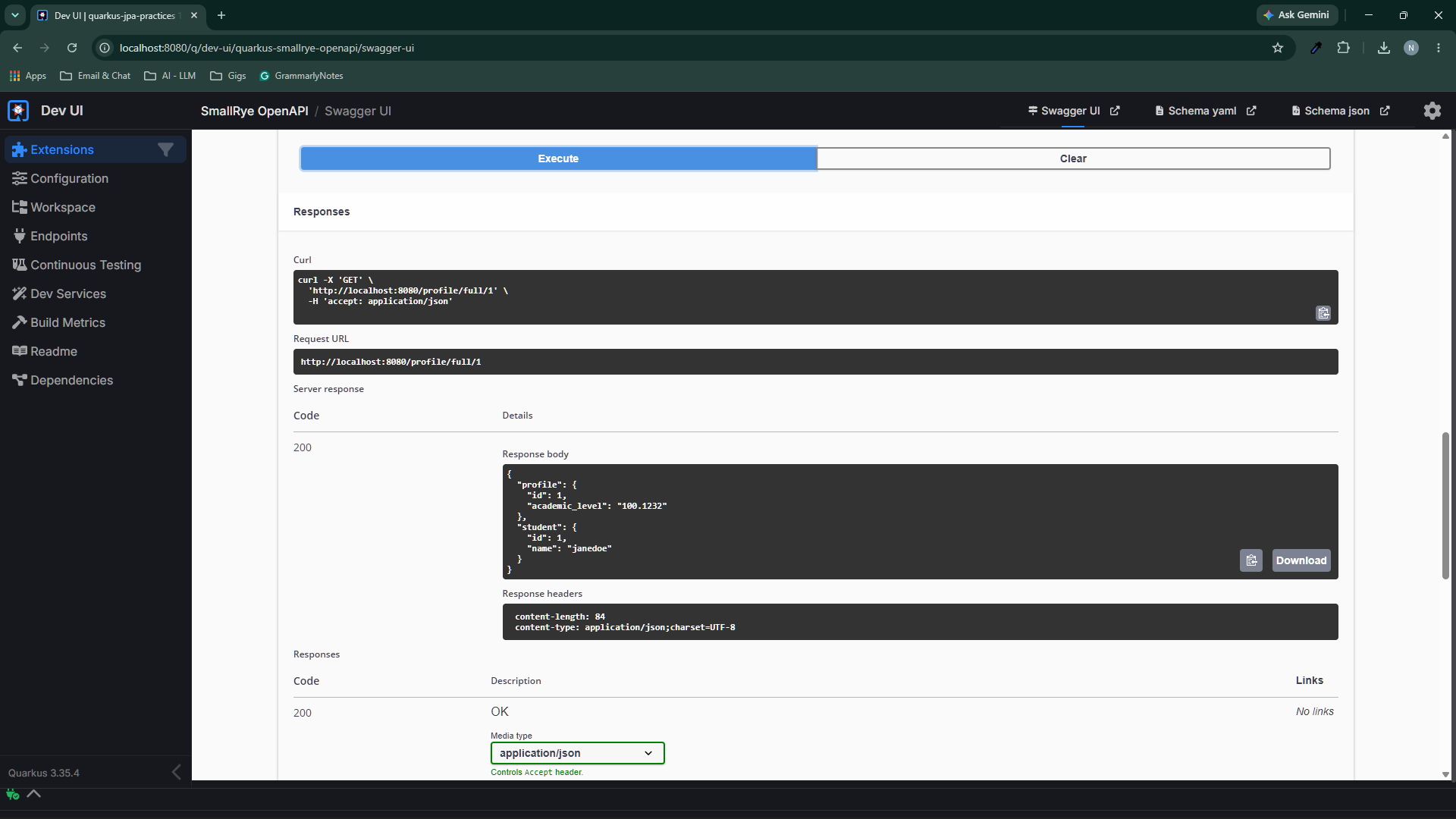
The log shown two SQL query from hibernate to database, 1 query call
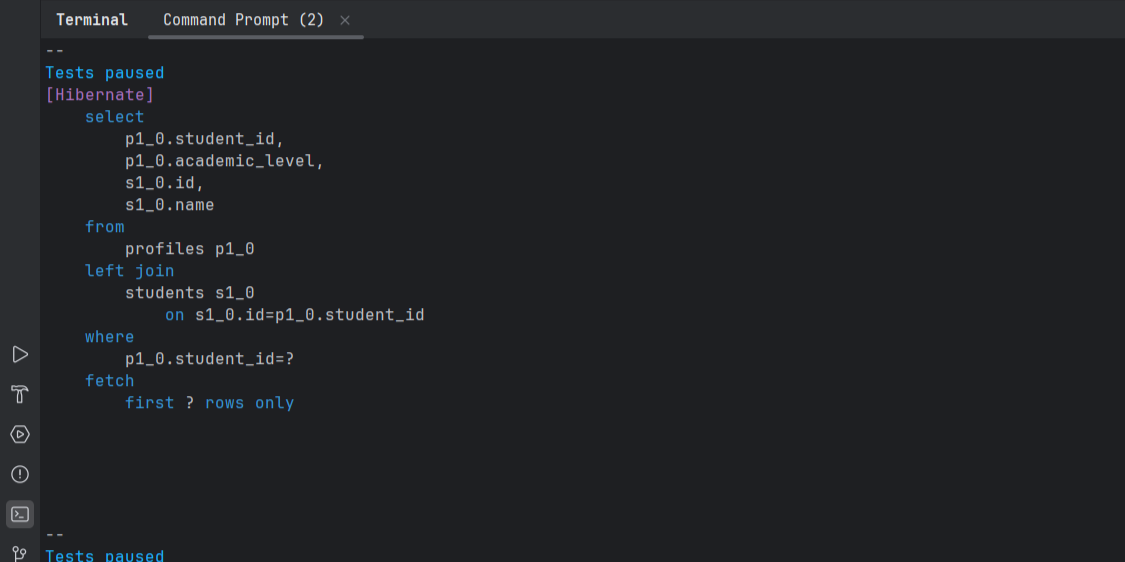
[Hibernate]
    select
        p1_0.student_id,
        p1_0.academic_level,
        s1_0.id,
        s1_0.name
    from
        profiles p1_0
    left join
        students s1_0
            on s1_0.id=p1_0.student_id
    where
        p1_0.student_id=?
    fetch
        first ? rows only
The gap above is per single record. It’s worth re-running this against a list endpoint (N profiles, not just one) to see the linear-vs-constant query growth directly, and that’s where N+1 actually hurts in production, not on a single-record GET.
Reproduce This Yourself
- Enable SQL logging in
application.properties:quarkus.hibernate-orm.log.sql=true(it is already enabled in this repository if you haven’t changed it)
- Run the app:
./mvnw quarkus:dev - Seed at least one
Profilewith a non-nullstudentrelation. - Hit both endpoints (via Swagger’s “Try it out”, or
curl) and watch the console output between each call. - Count the
selectstatements attributed to each request.
Takeaway
This isn’t an argument against PanacheEntityResource or against lazy loading, i am just sharing something i found out,
that the moment your endpoint serializes a relation, you’ve made a fetching decision, whether you meant to or not.
In a database wrapper service (the scope this template targets), where endpoints are often hit at high frequency by
other internal services, that decision compounds fast.
The fix demonstrated here: a custom finder with JOIN FETCH is deliberately small in scope. It doesn’t require
abandoning Panache’s Active Record style, just being explicit at the one point where it matters (relation fetching),
instead of trusting the default.