quarkus-panache-swagger-blueprint
📖 Introduction: Understanding the Use-Case Schema
To truly grasp JPA best practices, we must look at how object models translate into clean database structures. In this cheatsheet, we use a standard academic domain consisting of Students, Profiles, and Courses to demonstrate how a poorly designed schema can be refactored into a high-performance relational database.
In the initial model, our domain attempts to capture a standard academic workflow where a central students entity sits between its personal records and academic activities. Logically, each student is assigned a single, dedicated record in the profiles table to store extension data like academic levels. Simultaneously, these students interact with the courses catalog, creating a dynamic environment where a single student can attend multiple classes, and a single course can be filled by multiple students.
While this accurately reflects the conceptual business logic of a school, translating this three-way web of interactions directly into physical database columns without proper structure creates severe design conflicts, as the tables try to reference each other simultaneously without a clear owner or a proper junction bridge.
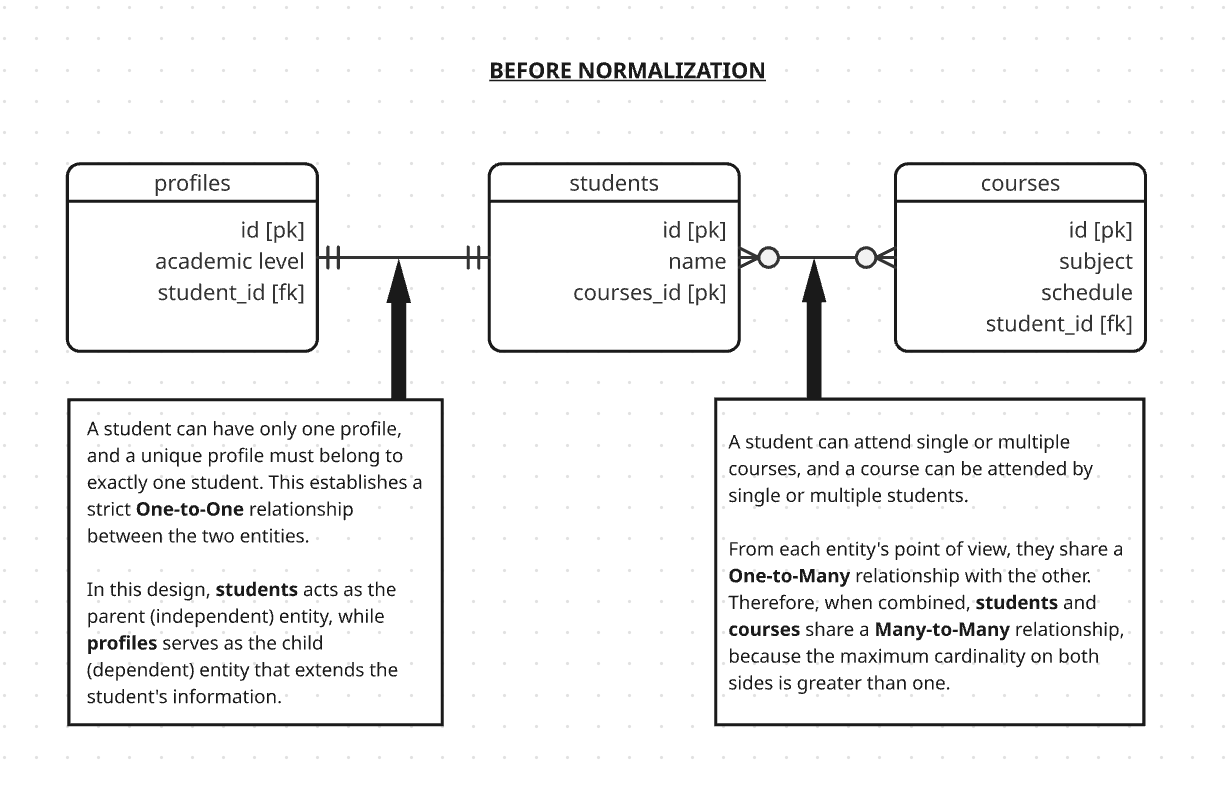
In the initial design, the schema suffers from classic relational and JPA anti-patterns:
- Redundant Indexes in 1:1 Relation: The
profilestable manages its own auto-incrementidalongside a separatestudent_id [fk], forcing the database to maintain two separate indexes for a strict 1:1 relationship. - The Impossible Many-to-Many Direct Link: The
studentsandcoursestables attempt to link directly to one another by placing foreign keys (courses_idandstudent_id) inside the main entity tables. In a real-world relational database, this setup breaks down completely, as a single table column cannot natively store multiple records without breaking first normal form (1NF) rules.
To fix these architectural flaws, the schema undergoes a complete normalization process to separate responsibilities and optimize entity lifecycles:
- Shared Primary Key Optimization (
profiles↔students): We eliminate the redundant profile ID. By utilizing JPA’s@MapsId, thestudent_idin theprofilestable now acts as both the Primary Key and the Foreign Key. The child table completely derives its identity from the parent, cutting index overhead by 50% and ensuring perfect 1:1 data integrity. - Deconstructing Many-to-Many (
students↔coursesviaenrollments): We break down the direct Many-to-Many link by introducing a dedicated junction entity namedenrollments. This deconstructs the complex association into two clean, predictable One-to-Many relationships. This junction table effectively isolates the relationship records, giving us full control over the database schema and preventing query anomalies.
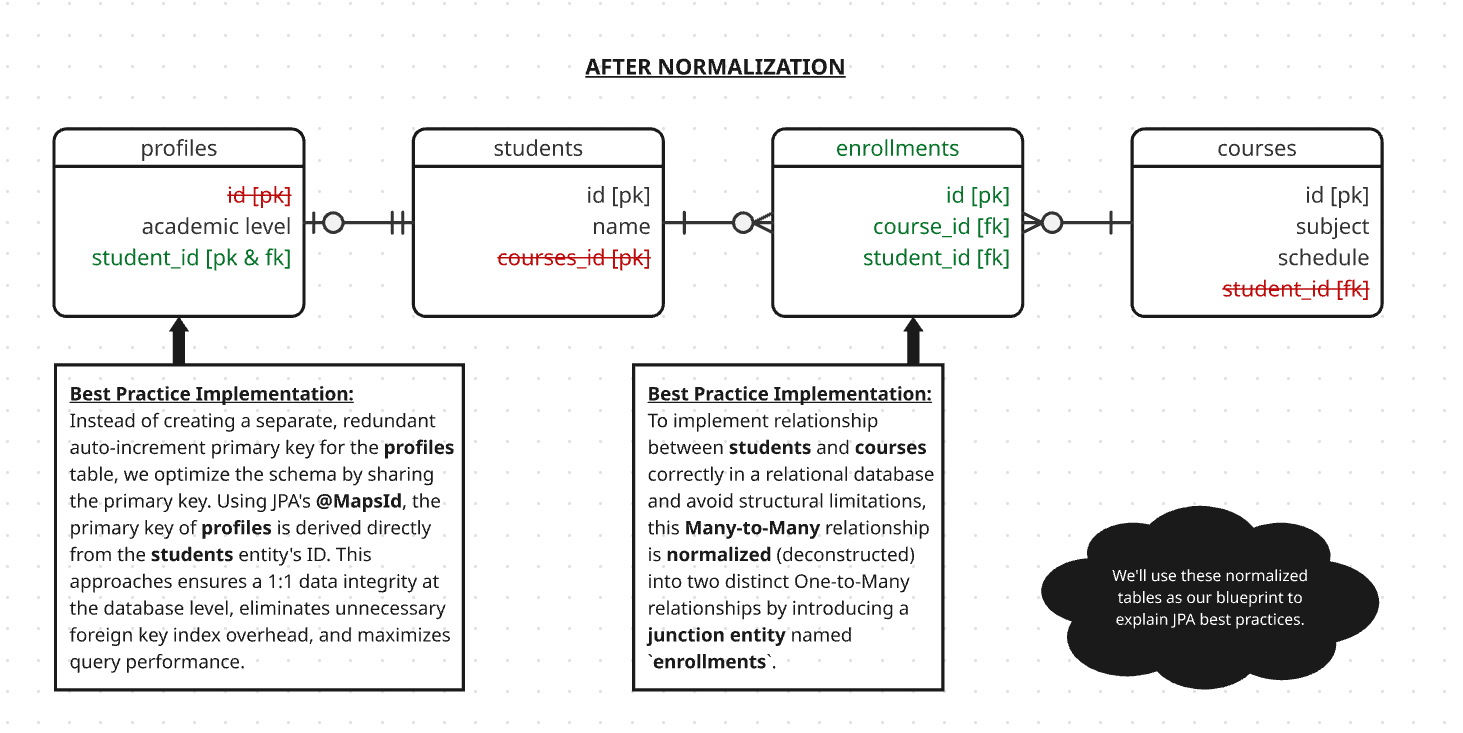
💡 Note: We will use these normalized tables as our primary blueprint throughout this cheatsheet to explain optimized JPA mapping and query practices in Quarkus.
📝 Architectural Note on One-to-One Separation between students and profiles:
In a production environment, you should not split a One-to-One relation into two separate tables (
studentsandprofiles) unless you absolutely have to. If a student only has an address and a level, keeping them in a singlestudentstable is simpler and faster.We purposely separate them in this repository for demonstration purposes to show how to implement a clean One-to-One mapping using
@MapsId.In real-world apps, you only apply this separation for Vertical Partitioning, for instance, when the profile table holds heavy data (like large text blobs or binary data) and you want to keep the main
studentstable lightweight and lightning-fast for frequent index scans.